Rating: 6/10
- Accuracy: Heavily researched; Stone lived in Italy and worked from Michelangelo’s letters, though dialogue and inner life are invented.
- Readability: Easy and informative, though the tone of reverence becomes monotonous.
- Plot: Michelangelo’s life from apprenticeship to old age, through the David, the Sistine Chapel and St Peter’s.
- Science bonus: Michelangelo’s secret anatomical dissections and his engineering knowledge of marble, quarrying and scaffolding are treated as essential to his art.
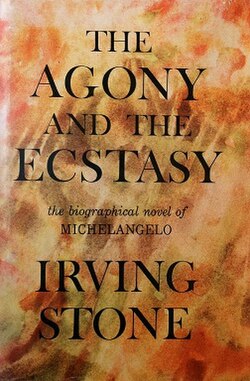
Irving Stone had already fictionalised Van Gogh in Lust for Life. With The Agony and the Ecstasy he turned to Michelangelo, and the result was one of the best-selling historical novels of the decade.
The book follows Michelangelo from his apprenticeship with Ghirlandaio in Florence, through the Medici sculpture garden, his early triumphs in Rome and Florence, the carving of the David, and the long struggle with Pope Julius II over the Sistine ceiling. Later chapters cover his work on St Peter’s and his old age.
Stone’s research is extensive. He spent years in Italy, visited quarries and studied marble carving, and drew on Michelangelo’s letters. The best passages are about technique: choosing stone, carving, the physical strain of painting a ceiling. They make the reader understand art as labour.
The weakness is characterisation. Michelangelo is presented as a heroic genius, suffering and misunderstood, and the book rarely questions that image. The dialogue is often stiff and expository. Popes, patrons and rivals appear mainly to obstruct or admire.
The novel is also very long, and its structure is simply chronological, one commission after another.
The 6 reflects a book that is educational and often absorbing, but more a biography in dialogue than a novel. It works as an introduction to Michelangelo and Renaissance Italy. The 1965 film, with Charlton Heston and Rex Harrison, covers only the Sistine chapter.


Leave a Reply