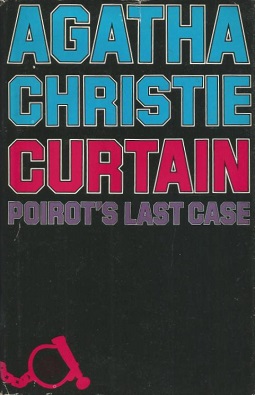
Rating: 7/10
- Plot: Poirot, old and crippled, summons Hastings back to Styles, where they first met, to catch a murderer who has never been caught.
- Clues: Subtle and psychological; the killer never needs to strike directly.
- Reveal: One of Christie’s most audacious endings, a final moral reckoning for her detective.
Hercule Poirot and Captain Hastings return to Styles Court, now a guesthouse, where they solved their first case in 1920. Poirot is ill, confined to a wheelchair and near the end of his life. He tells Hastings that one of the guests is a murderer, a person who has been connected to several deaths but has never been suspected. Poirot knows who it is, but won’t say.
Christie wrote Curtain during the Second World War and kept it in a vault, intending it to be published after her death. It was released in 1975, shortly before she died, and it was a major event. Poirot’s death was reported in The New York Times with an obituary on the front page.
The central idea is one of Christie’s darkest: a murderer who works by influence, manipulating others into killing. The novel explores guilt, responsibility and the limits of justice, and it gives Poirot a moral dilemma that brings his career to a remarkable end.
The atmosphere is autumnal and sad. Hastings, widowed and lonely, is poignant, and the return to Styles adds emotional weight.
The weaknesses are in the mechanics. The pace is slow, some characters are thin, and the plot depends on a highly improbable psychology.
The 7 reflects a bold, moving farewell that is more significant for its ending than for the whole. Readers should come to it having read The Mysterious Affair at Styles and a number of other Poirot novels.


Leave a Reply