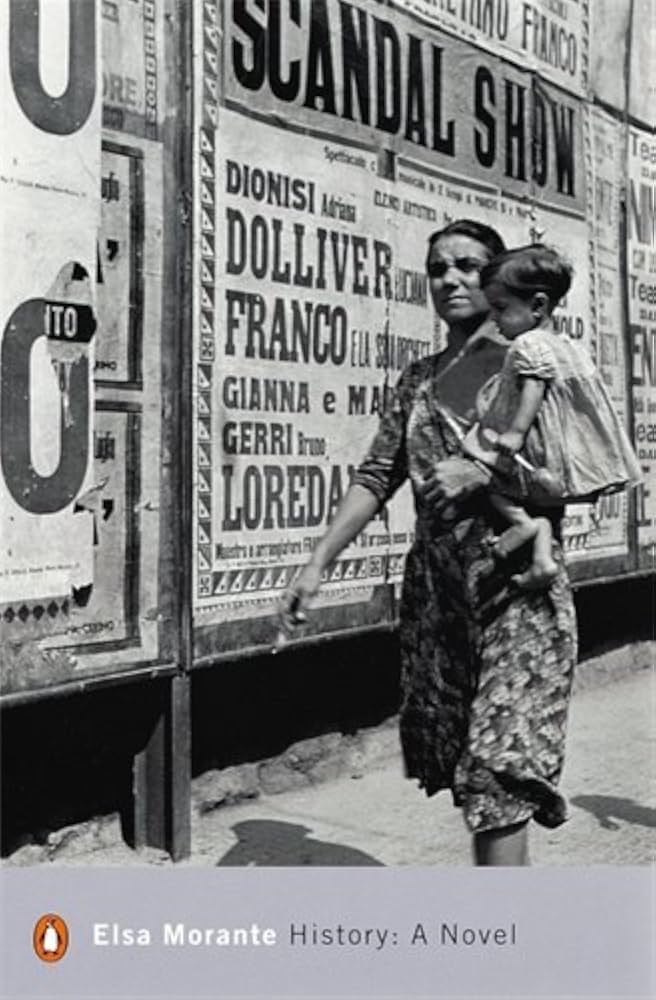
Rating: 9/10 · Translated from Italian (original title La Storia); English edition 1977
- Accuracy: Firmly grounded in Rome from 1941 to 1947, with each chapter introduced by a chronicle of world events.
- Readability: Long and emotionally draining, but written with great clarity.
- Plot: A widowed schoolteacher of partly Jewish descent and her young son try to survive the war and its aftermath in Rome.
Ida Ramundo is a widowed primary school teacher in Rome. She is half Jewish, and she lives in fear of discovery. In 1941 she is raped by a young German soldier, and she gives birth to a son, Useppe. The novel follows Ida, Useppe and her older son Nino through bombing, occupation, hunger and the war’s aftermath.
Elsa Morante’s intention was to tell history from the point of view of those who suffer it. Each chapter begins with a summary of world events, in capital letters, and then shows how those events affect ordinary people.
Useppe is one of the most extraordinary child characters in literature, joyful, curious and fragile. His perception of the world, and his relationships with animals and people, give the book its emotional centre. Ida’s fear and endurance are portrayed with great tenderness.
The novel was a bestseller in Italy and sparked controversy. Some critics thought its politics naive or sentimental. It is certainly an emotional book, and its ending is devastating.
The weakness is length and sometimes a didactic tone in the historical summaries. The novel can be overwhelming.
The 9 reflects a profound and humane novel, one of the great Italian books of the century. William Weaver’s translation made it available in English in 1977.


Leave a Reply