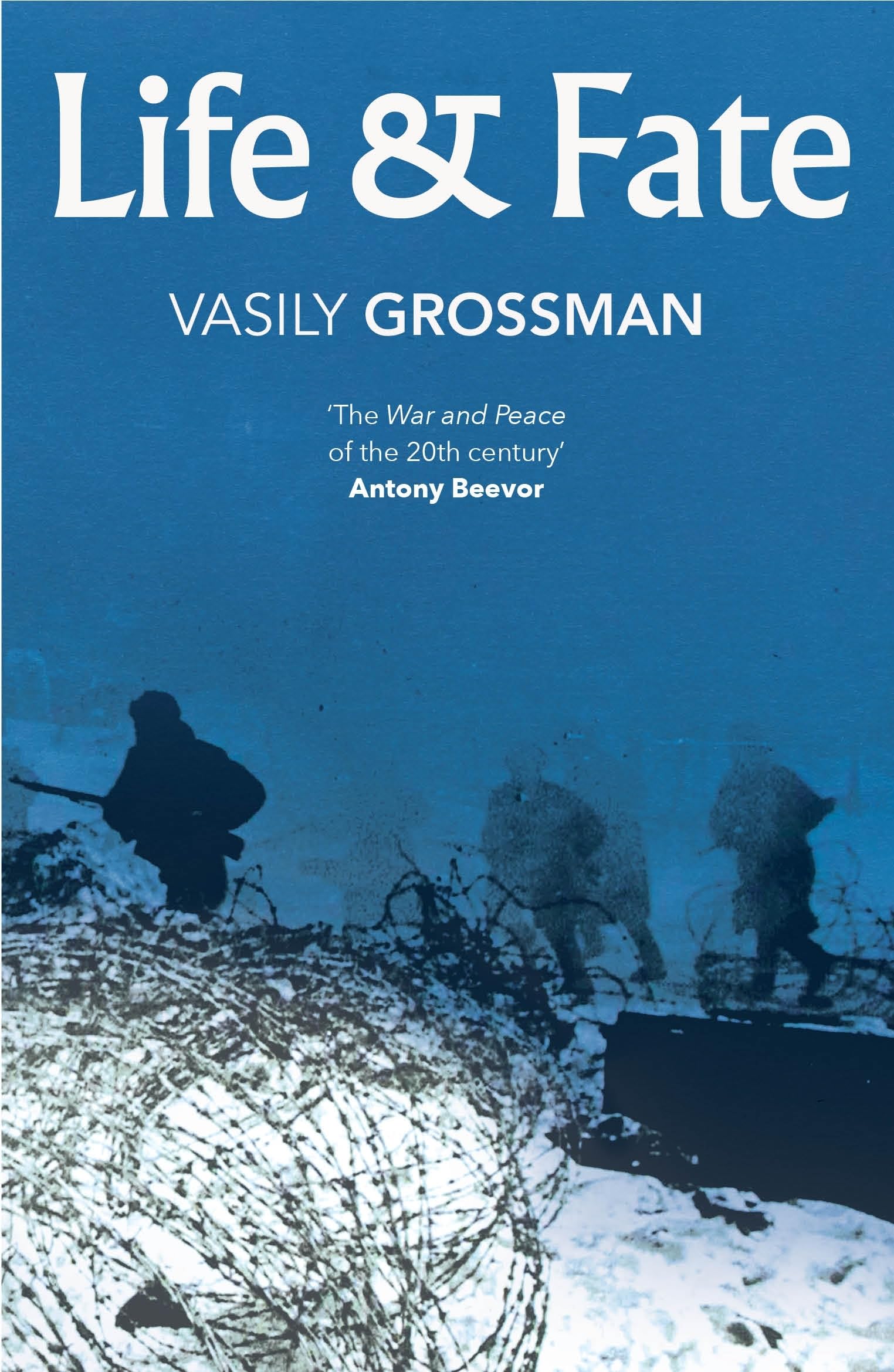
Rating: 10/10 · Translated from Russian; English edition 1985
- Accuracy: Written by a war correspondent who was at Stalingrad and who witnessed the Holocaust’s aftermath; exceptionally accurate on the battle and Soviet society.
- Readability: Long and demanding, with a vast cast, but lucid and deeply moving.
- Plot: Around the Battle of Stalingrad, a family and those connected to it face war, the Holocaust and the Soviet state.
- Science bonus: Viktor Shtrum’s breakthrough in nuclear physics, and the state’s shifting attitude to it, is one of the novel’s central threads, showing science caught between discovery and political control.
Vasily Grossman’s novel follows the Shaposhnikov family and those around them during the Battle of Stalingrad. There are soldiers in the ruins of the city, prisoners in German and Soviet camps, a physicist, Viktor Shtrum, whose scientific breakthrough coincides with political persecution, and many others.
Grossman was a Soviet war correspondent who covered Stalingrad and later reported on Treblinka. His mother was murdered by the Nazis in Berdichev. The novel includes a letter from Shtrum’s mother, written in a ghetto before her death, which is one of the most devastating passages in literature.
The book’s central argument is that Nazism and Stalinism were mirror images, both destroying human freedom. That made it unpublishable. In 1961 the KGB confiscated the manuscript, and a Soviet official said it could not be published for two hundred years. A copy survived and was smuggled to the West. It was published in Switzerland in 1980, after Grossman’s death.
The novel is often compared to War and Peace, and the comparison is deserved. It combines epic scope with deep humanity, showing how kindness survives in the worst circumstances.
The only difficulty is its size and complexity. Readers may need a list of characters.
The 10 reflects one of the great novels of the twentieth century. Robert Chandler’s translation is excellent.


Leave a Reply