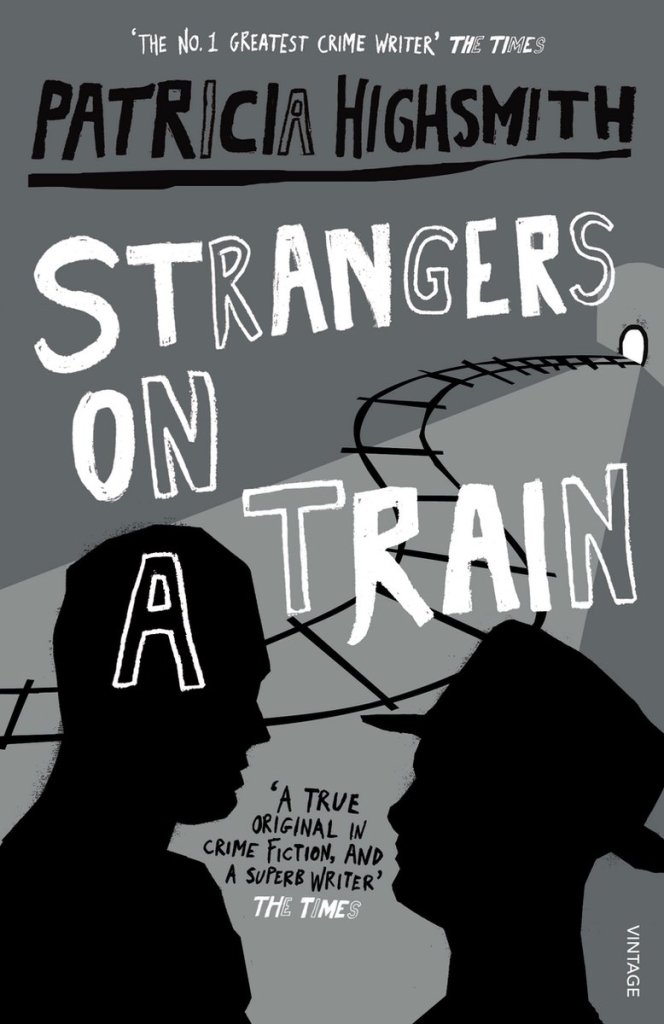
Rating: 8/10
- Plot: Two men meet on a train; one proposes swapping murders, and the other cannot un-hear the idea.
- Clues: Minimal. The investigation, run by a patient private detective, is slow pressure rather than a puzzle.
- Reveal: No whodunit to unveil. The ending turns on confession and conscience, and is bleaker than Hitchcock’s.
Highsmith’s first novel is a study of contamination. Guy Haines, an ambitious young architect, is travelling to Texas to arrange a divorce from his unfaithful wife, Miriam. In the dining car he meets Charles Anthony Bruno, a rich, drunken, mother-fixated idler who proposes a perfect crime: each man disposes of the other’s problem, and neither has a motive.
Guy laughs it off. Bruno doesn’t. When Miriam turns up dead, the real question emerges. It is not whether Guy will be caught, but how much of Bruno’s logic he will absorb.
Readers who know only the 1951 film will be startled. Hitchcock kept his hero clean; Highsmith doesn’t. The long middle, in which Bruno hounds Guy with letters, calls and uninvited appearances in his life, becomes almost unbearable. The two men settle into a kind of marriage, bound by guilt, need, and an attraction Highsmith hints at without naming.
Her prose is already recognisable: plain, attentive to small physical details, uninterested in consoling anyone. Bruno is a remarkable creation, grotesque and pitiable at once, and his alcoholism is rendered with a clinical precision decades ahead of its time.
The flaws are a debut’s. Guy’s architecture career gets earnest, lengthy passages that stall the tension. The investigator, Gerard, arrives late and works largely off the page. Some of Guy’s choices strain belief.
Still, the central idea is so strong, and its consequences pursued so relentlessly, that the novel earns its 8. It asks a question crime fiction rarely does: whether being tempted is itself a kind of guilt.


Leave a Reply