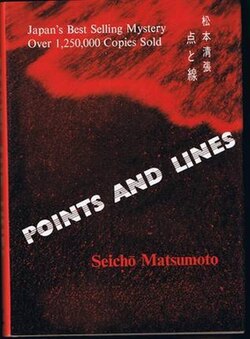
Rating: 7/10 · Translated from Japanese; English edition 1970
- Plot: A man and a woman found dead on a Kyushu beach look like lovers who chose to die together, until two detectives start to doubt it.
- Clues: Railway timetables, a dining-car receipt, and four minutes on a Tokyo platform.
- Reveal: A satisfying alibi-breaking solution that also points at corruption higher up.
The bodies of a government clerk and a restaurant hostess are found on a beach near Fukuoka. They seem to have taken poison together, a classic lovers’ suicide, and almost everyone accepts it. Two detectives do not: the veteran Torigai in Fukuoka and young Mihara from Tokyo.
Their doubts begin with small things. The man ate alone in the dining car. And someone saw the couple boarding their train at Tokyo Station, visible across several platforms during a four-minute window. That window, and the timetables built around it, become the heart of an alibi-cracking puzzle.
Matsumoto changed Japanese crime fiction. He turned away from the gothic mansions of writers like Yokomizo toward ordinary offices, ministries and stations, and made motive social rather than private. Here the dead man worked in a ministry under investigation for bribery, and the novel is as interested in how institutions protect themselves as in the mechanics of murder.
The detection is patient and appealingly unglamorous. Mihara spends pages checking passenger lists and flight records, and the exchanges with the older Torigai are modest, dogged and humane.
The weakness is characterisation. Beyond the two detectives, most people exist to serve the plot. The central alibi, once cracked, is ingenious but dry, and readers who dislike timetable puzzles may find it a slog. The English translation is also rather stiff.
The 7 reflects a historically important book with a clever plot and a quiet, persuasive social conscience. It sold enormously in Japan, and it explains a great deal about why Japanese crime fiction developed as it did.


Leave a Reply