Rating: 8/10 · Translated from French
- Accuracy: Among the most authentic portraits of 13th-century France; Oldenbourg was a trained medievalist who later wrote histories of the Crusades.
- Readability: Slow and immersive, with little concession to modern pacing.
- Plot: Three generations of a noble family: an old baron’s pilgrimage, his son’s violent rule, and his grandson’s courtly love.
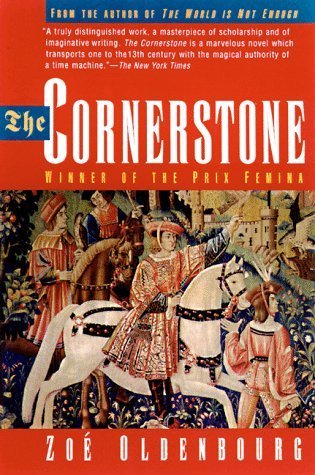
Zoé Oldenbourg was born in Russia, raised in Paris and trained as a medieval historian, and she wrote fiction as if the thirteenth century were the present. The Cornerstone, which won the Prix Femina, follows the family of Ansiau of Linnières, a baron in Champagne.
Ansiau, old and going blind, leaves his lands to seek salvation on pilgrimage to the Holy Land. His son Herbert, violent and passionate, rules in his place. His grandson Haguenier, young and idealistic, falls in love with a married lady and tries to live by the codes of courtly romance.
What distinguishes the book is its refusal to modernise. Faith, honour, hierarchy and brutality are presented without apology or commentary. People live close to death, in cold castles, among animals and dirt. Violence is ordinary. The ideals of the romances sit beside rape, feud and cruelty, and nobody in the book finds that contradiction strange.
Oldenbourg is unusually good on religious experience. Ansiau’s pilgrimage is both physical ordeal and spiritual search, and she treats his faith as serious rather than quaint.
For many readers the challenge is pace. The novel moves slowly, with long stretches of daily life and little conventional plot. Characters can feel distant, because Oldenbourg declines to give them modern psychology.
The 8 reflects an extraordinary act of historical imagination and one of the best medieval novels of the century. Readers after adventure should look elsewhere. Readers who want to feel what the thirteenth century might have been like will find few better guides. Her later Destiny of Fire, on the Cathars, makes a natural companion.


Leave a Reply