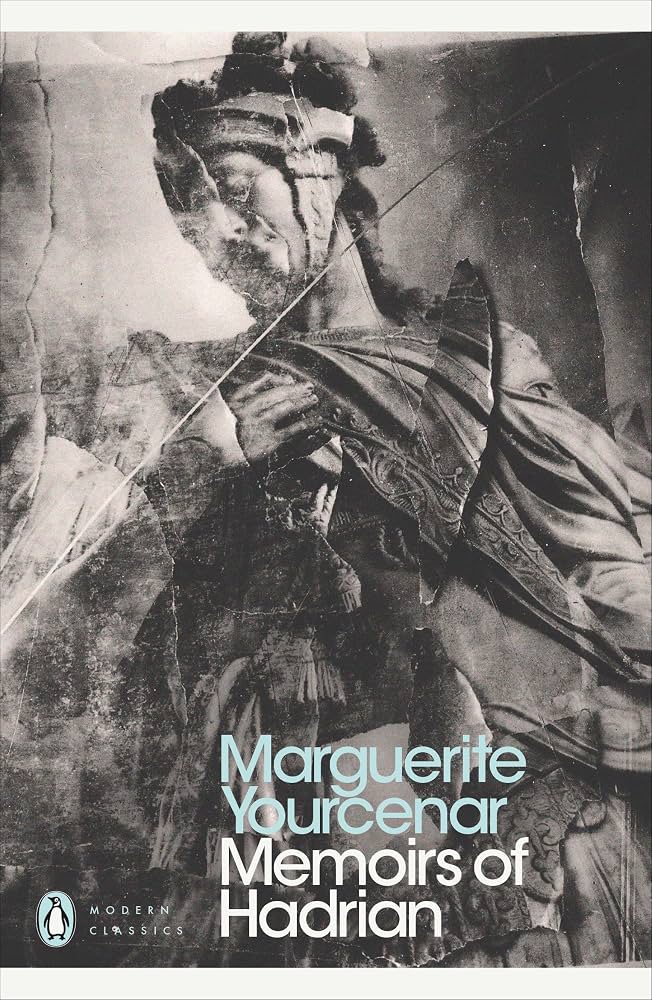
Rating: 10/10
- Accuracy: Meticulous. Yourcenar added a note explaining what is documented and what she invented.
- Readability: Demanding. There is no dialogue, and the sentences reward slow reading.
- Plot: A whole life rather than a story: travels, war, love, grief and the slow work of dying.
The novel is a letter. The Emperor Hadrian, ill and aware his time is short, writes to the young Marcus Aurelius, whose eventual succession he has arranged. What begins as a report on his failing body becomes an account of how he governed, whom he loved, and what he believed a civilised order required.
Yourcenar spent much of her adult life on this book. She began it in her twenties, destroyed drafts, abandoned it for years, and returned after the war. The result reads less like a historical novel than a voice recovered from the second century. Hadrian’s intelligence is restless and precise. He considers food, sleep, hunting, Greek poetry, frontier defence and the handling of the Senate with the same even attention.
At the centre is Antinous, the Bithynian youth Hadrian loved, and his death in the Nile. Yourcenar handles it with great restraint. The grief is not described so much as allowed to change the tone of everything after. Later pages on the Jewish revolt under Bar Kokhba show a ruler whose tolerance breaks down, and she does not excuse him.
Accuracy is a strength, not a burden. Where the sources are thin, she invents consistently with them, and her afterword on the book’s composition is an essay worth reading in its own right.
It is not easy. Readers expecting scenes will find page after page of reflection. But the prose, in Grace Frick’s English translation made with the author, has a sustained gravity few novels attempt. The 10 is for a portrait of a mind, and for showing what historical fiction can do when it trusts the reader.
Still, the book earned its readers. It made an obscure figure famous, and it shows how a limited viewpoint can make large events feel intimate. The 1954 film cast Marlon Brando as Napoleon and Jean Simmons as Désirée.
The 6 reflects a novel that is pleasant rather than profound. As light historical fiction, it does what it sets out to do, and does it warmly.


Leave a Reply