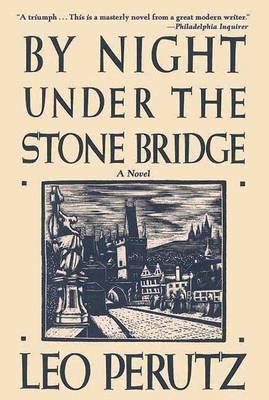
Rating: 8/10 · Translated from German; English edition 1989
- Accuracy: A rich, precise evocation of Rudolf II’s Prague around 1600, blending recorded figures with legend.
- Plot: Linked stories, jumping in time, about the emperor, the Jewish Town and the financier Mordechai Meisl.
- Clues: The reader’s detective work is connecting the stories; details in one explain events in another.
- Reveal: No single culprit, but the final pieces lock the stories into a satisfying hidden pattern.
Leo Perutz, born in Prague and driven from Vienna to Palestine in 1938, worked on this book for decades. It appeared in 1953 to little notice, and English readers had to wait until 1989. It is now widely regarded as his masterpiece.
The setting is Prague at the turn of the seventeenth century, under the melancholy Emperor Rudolf II, who collected art and curiosities, patronised astrologers and alchemists, and let his empire drift. In the Jewish Town lives Mordechai Meisl, a real financier, with his beautiful wife Esther. Rabbi Loew, the legendary maker of the golem, is here too.
The book is built from linked stories that leap back and forth in time, beginning with a plague among the ghetto’s children. Only gradually do you see how they connect: a love that should never have existed, a spell cast under the stone bridge, and consequences that pass through lives and years. Perutz leaves the clues in plain view but in the wrong order, and the pleasure lies in assembling them.
That is why it belongs, loosely, among historical mysteries. There is no detective and no crime in the usual sense, but the structure is one of concealed connection and delayed revelation. When the last pieces fall into place, the effect resembles the final chapter of a well-made puzzle.
Perutz’s prose is precise, ironic and humane, and the atmosphere of Rudolfine Prague, magical, anxious and beautiful, is superb. Some stories are stronger than others, and readers expecting a conventional narrative may struggle early on.
The 8 reflects a strange, beautiful book that rewards patience. Borges admired Perutz, and here it is easy to see why.


Leave a Reply