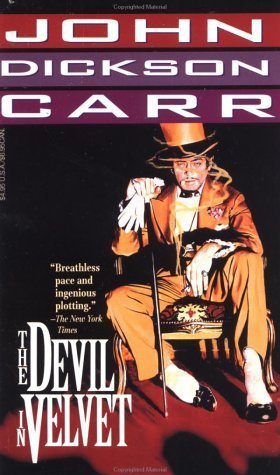
Rating: 8/10
- Accuracy: Carr knew Restoration London closely and appended notes explaining his sources.
- Plot: A Cambridge historian sells his soul to travel back to 1675 and prevent a poisoning, waking in the body of the victim’s husband.
- Clues: Fairly planted, with Carr’s usual sleight of hand. The hero knows a death is coming but not how.
- Reveal: A satisfying turn that works both as detection and as a comment on the bargain itself.
Professor Nicholas Fenton, a Cambridge historian in 1925, is obsessed with an unsolved crime: the poisoning of Lydia, wife of Sir Nicholas Fenton, in 1675. He makes a pact with the devil to go back and prevent it. He wakes in Sir Nick’s body, in Sir Nick’s London, with the murder still ahead and no idea who is planning it.
This is Carr at his most exuberant. He was a master of the impossible crime, and he approached history with an enthusiast’s knowledge and an entertainer’s appetite. The Restoration arrives full of sword fights, tavern brawls, coffee-house politics and backstairs intrigue. Charles II, Shaftesbury and the Green Ribbon Club all play parts, and the struggle between court and opposition drives much of the plot.
The time-travel conceit adds a second layer. Fenton knows history in outline but not the details, and he struggles against Sir Nick’s personality, which tends to take over, especially when blades come out. There is also a moral question about the bargain and what he is allowed to change.
Carr’s research shows. His closing notes cite sources for the period’s slang, weapons, streets and customs, and those details give the book an authenticity most historical adventures of the time lacked.
The weaknesses are Carr’s usual ones. The romance is overheated, the women divide into saints and schemers, and the dialogue can be arch. The pace is uneven, with too much swordplay between clues.
Still, as a blend of puzzle, adventure and historical imagination, it has few equals. The 8 rewards the ambition. Many Carr readers rank it his best historical novel, and it is easy to see why.


Leave a Reply