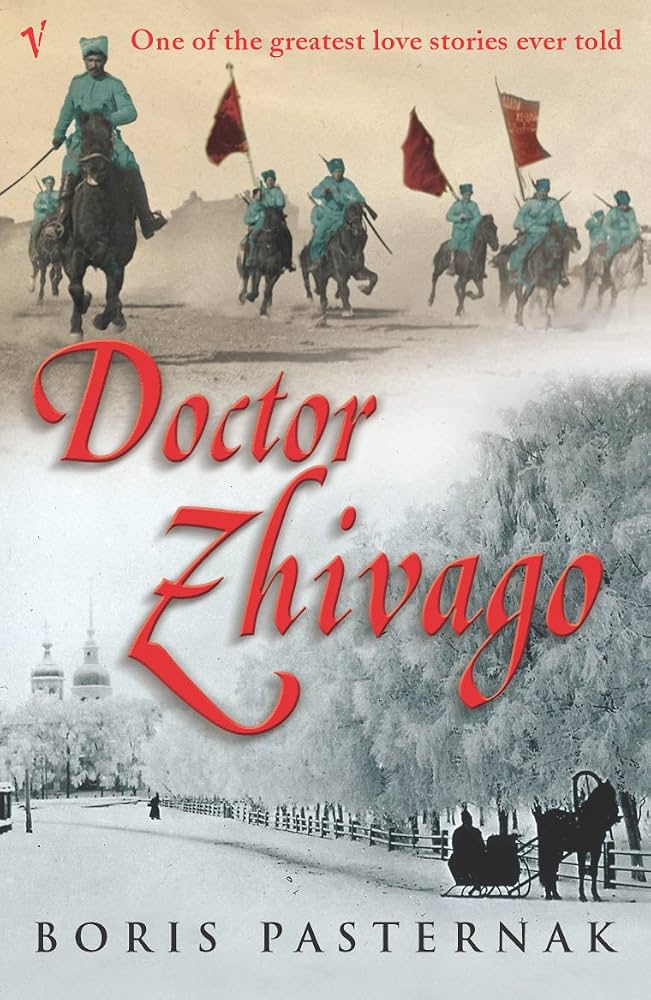
Rating: 9/10 · Translated from Russian
- Accuracy: The Revolution, Civil War and early Soviet years carry an eyewitness’s authority, filtered through one poet’s sensibility rather than documented.
- Readability: Lyrical but demanding; the large cast, Russian names and loosely linked episodes slow many readers.
- Plot: Yuri Zhivago, doctor and poet, is swept across Russia by war and revolution, torn between his wife Tonya and Lara.
Pasternak was a poet before he was a novelist, and Doctor Zhivago reads like a poet’s account of history. It follows Yuri Zhivago from an orphaned childhood through medical training in Moscow, service in the First World War, the Revolution, and the Civil War, when partisans in Siberia press him into service.
Around him move the people who shape his life: Tonya, his gentle wife; Lara, whom he loves; Komarovsky, the corrupt lawyer who exploited Lara as a girl; and Strelnikov, Lara’s husband, whose revolutionary idealism hardens into mercilessness. The characters keep meeting by chance across a vast country. Some readers find this implausible; others see it as Pasternak’s way of showing history binding lives together.
The great passages are about weather, landscape and stillness: winter at Varykino, a candle in a window, snow over Moscow. Pasternak cares less for battles than for how history breaks into private life, and how a person keeps an inner freedom.
The book’s publication was itself history. Refused in the Soviet Union, it was smuggled to Italy and published by Feltrinelli in 1957, the same house that issued The Leopard. Pasternak won the Nobel Prize in 1958 and was forced to decline it.
Its difficulties are real. The plot is episodic, the coincidences strain belief, and characters can feel more like symbols than people. The first English translation, by Max Hayward and Manya Harari, was rushed, and newer ones are available.
The 9 reflects a flawed but profound novel, one of the essential books about the Russian Revolution and a sustained argument for individual conscience against historical necessity. The poems at the end, attributed to Zhivago, are part of its meaning, not an appendix.


Leave a Reply