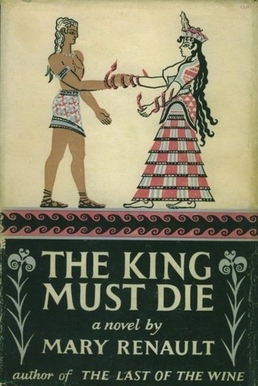
Rating: 9/10
- Accuracy: Speculative but grounded in archaeology; the myths become plausible Bronze Age politics, ritual and power.
- Readability: Brisk first-person narration by Theseus, vivid and physical.
- Plot: A driven sequence from Troizen to Eleusis, Athens and Crete, ending in catastrophe at Knossos.
Renault takes the legend of Theseus and asks what might have happened if there were no gods, only people who believed in them. Theseus narrates his youth in Troizen, where he is small for a hero and unsure who his father is. On the road north he becomes king at Eleusis by the grim custom of killing the old king, reaches Athens and his father, and then sails to Crete among the tribute youths bound for the bull-ring.
The Cretan chapters are the novel’s heart. Theseus and his companions become bull-dancers, athletes who vault charging bulls before the crowds at Knossos. Renault makes the training, the team loyalty and the fear concrete. The labyrinth is a palace, the Minotaur a man, and Minoan power ends in an earthquake.
Accuracy here means plausibility rather than documentation, because the evidence is myth, fresco and potsherd. Renault drew on Arthur Evans’s excavations and the Linear B decipherment of the early 1950s, and on theories of sacred kingship current in her day. Some of those theories, especially the neat opposition of earth-mother religion and sky-father patriarchy, are now out of favour. But the book never reads like a thesis.
What stands out is Theseus himself: vain, brave, quick, pious in his way, and learning that kingship means sacrifice. His voice has none of the stiffness mythological fiction usually carries.
It falls short of 10 because some episodes, especially at Eleusis, resolve faster than their setup deserves, and the women are mostly seen through a warrior’s frame. The sequel, The Bull from the Sea, completes his story, but this is the stronger book.


Leave a Reply