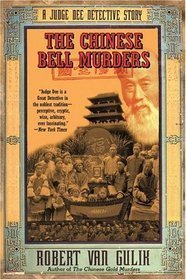
Rating: 8/10
- Accuracy: Legal procedure, customs and administration are exact, though van Gulik openly mixed Ming practice into a Tang setting.
- Plot: Three unrelated cases run at once, as in traditional Chinese detective fiction.
- Clues: Fair, physical and observational, down to the details of an abandoned bell.
- Reveal: Each case resolves cleanly; the bell case supplies a memorable final image.
Judge Dee takes up his post as magistrate of Poo-yang and finds three cases waiting: the rape and murder of a young woman, for which a student has been arrested; a Buddhist temple whose fertility miracles look suspect; and a feud between a widow and a wealthy merchant, involving a skeleton under an old bronze bell.
Van Gulik, a Dutch diplomat and sinologist, reached Judge Dee through translation. He had translated an eighteenth-century Chinese detective novel about Di Renjie, a real Tang official, and then began writing his own. His novels keep traditional features: the magistrate as detective, several cases at once, harsh punishments, and illustrations in the style of old woodblock prints, drawn by van Gulik himself.
The result is instructive as well as entertaining. You learn how a district court worked, how evidence was gathered, and why a confession was essential. The magistrate is judge, investigator and administrator at once, and his assistants, especially the former highwaymen Ma Joong and Chiao Tai, give the book colour.
It is also franker than many Western mysteries of the 1950s. It deals with sexual violence and religious fraud, and punishments are described without euphemism. Some readers will find that jarring, but it reflects the source tradition.
The characters remain more functional than rich. Dee is upright, clever and somewhat remote, and the book does not look far into his inner life. The 8 is for the quality of the puzzles and the originality of the setting. For many readers this is the best way into van Gulik’s world, and it holds up well.


Leave a Reply