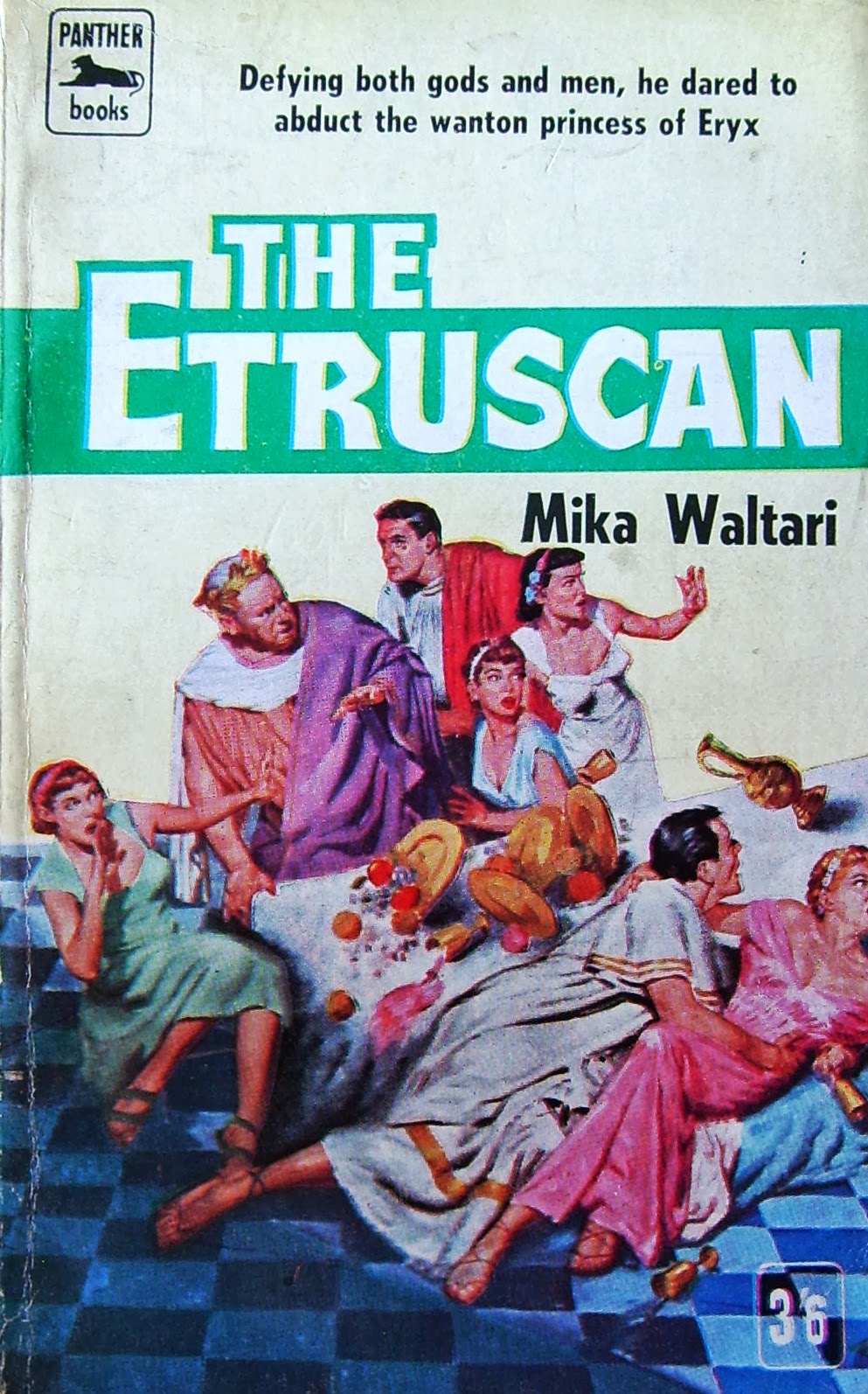
Rating: 6/10 · Translated from Finnish
- Accuracy: Rich in period detail on the Greek, Sicilian and early Roman world of the 5th century BC, though Etruscan religion is largely conjecture.
- Readability: Smooth and absorbing, in a reflective first-person voice.
- Plot: Turms, a man of unknown origins, wanders the Mediterranean before coming to believe he is something more than mortal.
Mika Waltari became internationally famous with The Egyptian, a vast first-person novel of Akhenaten’s Egypt. The Etruscan applies the same method to a stranger subject: a civilisation whose language can be read but is only partly understood.
Turms, the narrator, does not know his parents. He grows up in Ionia, is swept into the Ionian revolt against Persia, and is accused of sacrilege. He flees west through Greece and Sicily, fights, loves and loses, passes through the young Roman republic, and finally reaches Etruria, where the priests seem to recognise him as someone returned.
The early sections have an adventurer’s energy. Waltari’s Greek world is cynical and vivid, full of oracles, athletes, mercenaries and politicians, and the Sicilian episodes are especially lively. Turms’s voice, disillusioned, curious and sensual, keeps things moving.
As the story nears Etruria it turns mystical. Waltari imagines Etruscan religion as a system of omens, sacred kingship and return, and Turms’s growing belief in his own immortality becomes the main subject. Some readers find this haunting; others find it vague and slow. Because so little is known of Etruscan belief, much of it reads more like Waltari’s own spirituality than like history.
The characterisation is also thinner than in The Egyptian, and women tend to be idealised or dangerous.
The 6 reflects a readable, atmospheric but uneven novel. Admirers of The Egyptian may enjoy it, but it is not the place to start with Waltari. Its real strength is the sense of a Mediterranean in motion before Rome swallowed it.


Leave a Reply