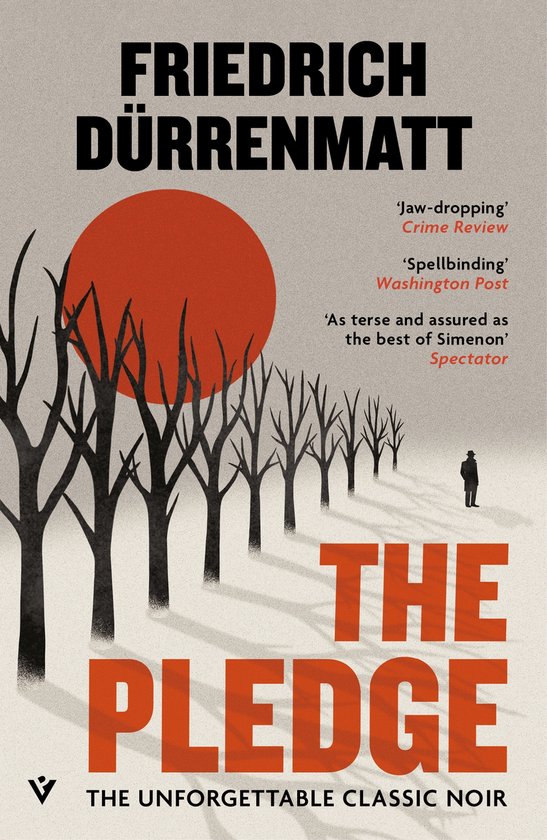
Rating: 9/10 · Translated from German
- Plot: A detective promises a murdered girl’s mother that he will find the killer, and keeps the promise long after it stops making sense.
- Clues: Methodical and sound: a child’s drawing, a car, a pattern of places. The detective reasons correctly.
- Reveal: The truth arrives, but not in a way that rewards reasoning, which is exactly the point.
The book is framed as a conversation. A crime novelist gives a lecture in Chur, and afterwards a former Zurich police chief tells him that detective stories lie, because they pretend the world runs on logic. Then he tells him about Matthäi.
Inspector Matthäi, brilliant and cold, is about to leave for a posting in Jordan when a young girl is found murdered in a wood. He has to break the news to her parents, and her mother makes him swear on his salvation to find the killer. A pedlar confesses and hangs himself, the case is closed, and Matthäi departs. Then, at the airport, he turns back.
What follows is a descent. Convinced the real killer is still free, Matthäi resigns and takes over a petrol station on a road he thinks the man must use. He takes in a woman and her small daughter, and waits. His logic is flawless and grows steadily more monstrous.
Dürrenmatt wrote the book after scripting the film It Happened in Broad Daylight, which ended with the killer caught. The novel keeps the material but removes the consolation. The detective’s method is right, but the world refuses to cooperate. Chance, not intelligence, decides.
It is short, precise and bleak. The frame gives it the air of a parable, and Matthäi’s change from rational investigator to obsessive is one of the most unsettling character studies in crime fiction.
It falls short of 10 only because the narrator’s argument is spelled out a shade too explicitly, and the brevity leaves some characters thin. But few books have challenged the genre so directly. It has been filmed several times, most notably by Sean Penn in 2001.


Leave a Reply