Rating: 7/10
- Plot: A dying woman’s confession, a murdered priest and a list of names lead to a country inn where three women claim they can kill by ritual.
- Clues: Excellent on the method, which is hidden behind the occult trappings; thinner on the people.
- Reveal: The how is superb; the who is a little arbitrary.
- Science bonus: Christie’s pharmacological knowledge is the solution, with thallium poisoning described so precisely from its symptoms that real clinicians later recognised cases from the book.
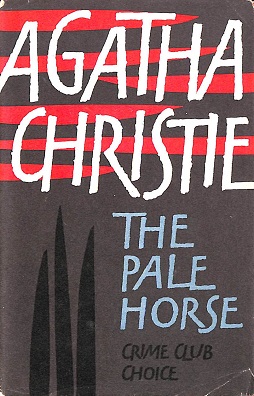
Father Gorman is called one foggy London evening to hear a dying woman’s confession. On his way home he is killed, and in his shoe the police find a list of names. Several of those people have died recently, all of apparently natural causes.
Mark Easterbrook, a scholarly writer who narrates much of the book, starts to connect the list with the Pale Horse, a converted inn in a Wiltshire village occupied by three women who talk openly about witchcraft. For a fee, it is whispered, they can arrange a death at a distance.
This is Christie’s most knowing play with the supernatural. The séance scene is genuinely eerie, and she lets the reader half believe before pulling the curtain. Ariadne Oliver, her comic self-portrait, drops in and supplies a vital idea almost by accident.
The real achievement is the method. Christie had worked in a hospital dispensary in both world wars, and her knowledge of poisons was professional. The book describes symptoms so exactly that, in the years after publication, readers are reported to have recognised real cases of thallium poisoning from it. Few crime novels can claim to have saved lives.
The weaknesses are in the cast. Easterbrook and his ally Ginger are pleasant but thin, and the eventual culprit is less inevitable than Christie’s best solutions. The shifts between first and third person also feel untidy.
The 7 reflects a book whose central idea is among Christie’s cleverest, wrapped in a story that is atmospheric but not quite as tightly engineered as her classics.


Leave a Reply