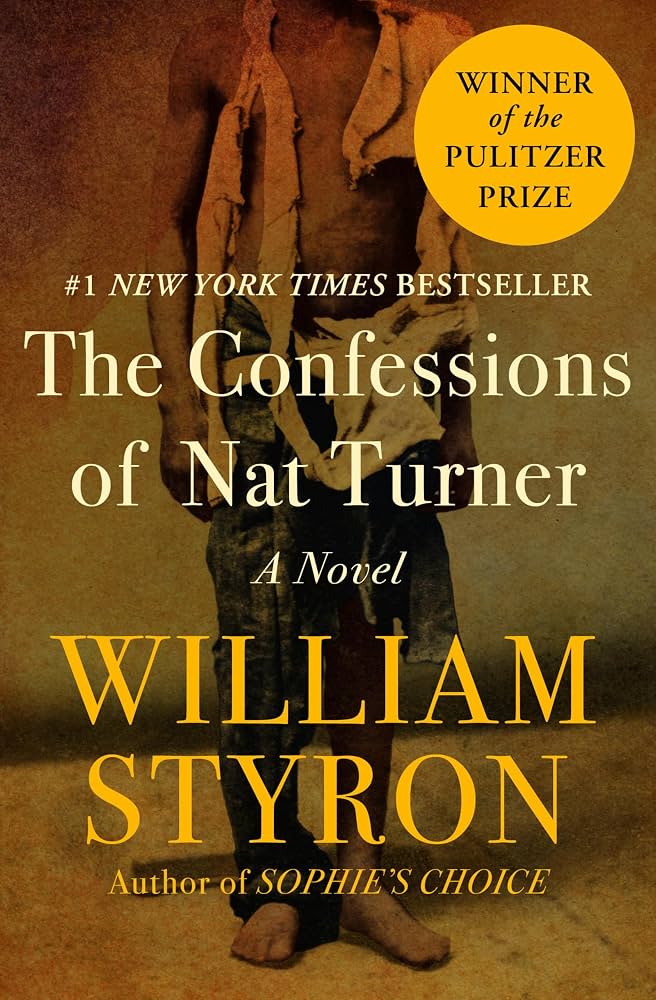
Rating: 7/10
- Accuracy: Built on the short 1831 ‘Confessions’ recorded by lawyer Thomas R. Gray, but Styron invents Turner’s inner life, including a fantasy about a white woman that critics considered unfounded and damaging.
- Readability: Rich and eloquent, though the ornate first-person voice can feel false.
- Plot: Awaiting execution, Nat Turner recalls his life as an enslaved preacher and the bloody revolt he led in Southampton County, Virginia.
In August 1831 Nat Turner, an enslaved preacher in Virginia, led a revolt in which about sixty white people were killed. The rebellion was crushed, and in reprisal many more Black people were murdered. Before his execution, Turner dictated a short confession to Thomas R. Gray, a lawyer, who published it.
William Styron, a white Southern writer, expanded that document into a first-person novel. It traces Turner’s childhood, his education, his religious visions, his relationships with slaveholders who alternately indulge and abuse him, and the planning and execution of the revolt.
The book was a sensation. It won the Pulitzer Prize in 1968, and it was attacked in a volume of essays by Black writers who argued that Styron had distorted Turner’s life, particularly by inventing his sexual obsession with a young white woman, Margaret Whitehead, the one person he killed himself.
That controversy is the lens through which the book is now read. Styron’s intelligence, his feeling for landscape and his attempt to imagine slavery from within are evident. So are the limits of that imagination. Turner’s voice is often more Styron’s than a nineteenth-century preacher’s.
The revolt itself is written with horrifying power, and the portrait of Southern society is sharp.
The 7 reflects an ambitious, skilfully written novel whose central act of ventriloquism is deeply contested. It is essential reading for its place in American debates about who can tell whose story.


Leave a Reply