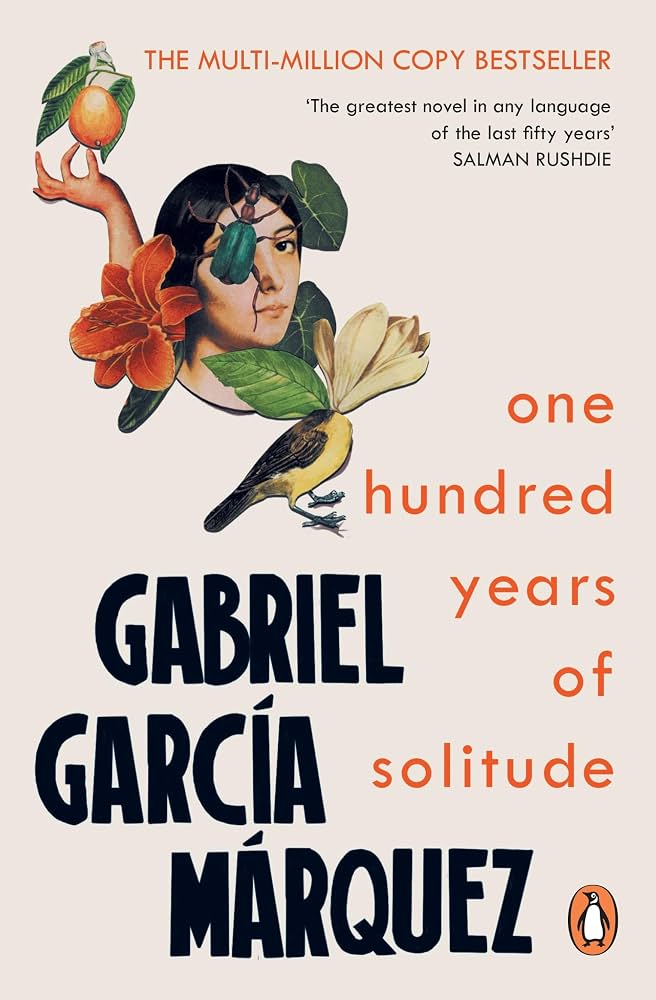
Rating: 10/10 · Translated from Spanish; English edition 1970
- Accuracy: Not a documentary novel, but the civil wars, the arrival of the railway and the foreign banana company, and the 1928 massacre of striking workers are all real history transformed.
- Readability: Enchanting but demanding, with repeating family names and a vast span of time.
- Plot: Seven generations of the Buendía family in the town of Macondo, from its founding to its end.
- Science bonus: José Arcadio Buendía’s experiments with magnets, lenses, alchemy and the astrolabe, including his lonely proof that the earth is round, make proto-science one of the book’s great comic and tragic threads.
José Arcadio Buendía founds the town of Macondo in a swamp, obsessed with alchemy, magnets and the gypsy Melquíades’s inventions. His wife Úrsula, practical and enduring, keeps the family going for more than a century. Their descendants, repeatedly named José Arcadio and Aureliano, fight wars, fall in love, build fortunes and repeat each other’s mistakes.
It is often called magical realism, and the magic is famous: a rain of yellow flowers, a woman who ascends to heaven while hanging laundry, a plague of insomnia that erases memory. But the book is also a history of Colombia and of Latin America. Colonel Aureliano Buendía launches thirty-two uprisings and loses them all. The railway arrives, and with it a foreign banana company. Striking workers are massacred, and the official version insists nothing happened.
That erasure is the historical heart of the novel. García Márquez shows how memory is manipulated and how a community can be persuaded to forget its own dead, a theme that makes the book as relevant as ever.
The prose, in Gregory Rabassa’s celebrated translation, is dense, rhythmic and comic, full of long sentences that move across years in a breath. The repetition of names is deliberate, reinforcing the sense of cyclical history.
Its difficulty is real. Many readers need a family tree, and the density can overwhelm. The 10 reflects one of the great novels of the century, a book that reinvented how Latin America could be written, and one in which history, myth and family chronicle become inseparable.


Leave a Reply