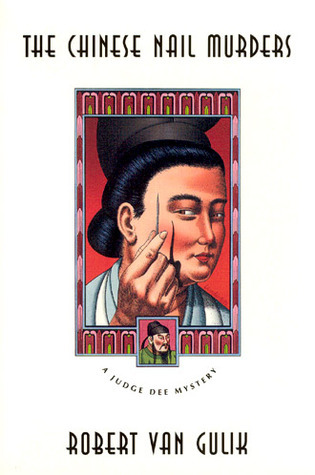
Rating: 8/10
- Accuracy: Excellent on the northern frontier, winter conditions, and the procedure for exhumation and autopsy under imperial law.
- Plot: In a cold frontier district, a headless body, a poisoned boxing master and a merchant’s death years before all converge on Judge Dee.
- Clues: Tightly constructed, including one of van Gulik’s most memorable forensic ideas.
- Reveal: Dark and effective, though the emotional aftermath is the book’s strongest note.
- Science bonus: The nail case is solved through a forensic method recorded in old Chinese coroners’ literature, and Dee’s exhumation is an evidence-based gamble with his career.
The district of Pei-chow lies on the northern frontier, cold and remote. Judge Dee faces three cases: a headless woman’s body found in an antique dealer’s shop, the death of a respected master of martial arts, and suspicions about an old death that was recorded as natural.
The third case forces Dee into a crisis. To prove murder, he must exhume a body, and if he is wrong, the law allows him to be punished severely. He stakes his career on his deduction.
This was the last of van Gulik’s first five Judge Dee novels, and many readers think it the finest. The cases are grim and ingenious, the frontier setting is well drawn, and Dee’s position is more precarious than usual.
The forensic puzzle at the heart of the nail case is a genuinely clever idea, based on a method recorded in old Chinese detective literature. The martial arts world is also well described.
The weaknesses are the familiar ones. Characters beyond Dee are thin, and some of the portrayal of women relies on type. The prose, formal as always, is occasionally stiff.
The 8 reflects a tense, well-constructed novel with an unusually personal cost for its detective. It also shows van Gulik at his most confident as a plotter.


Leave a Reply