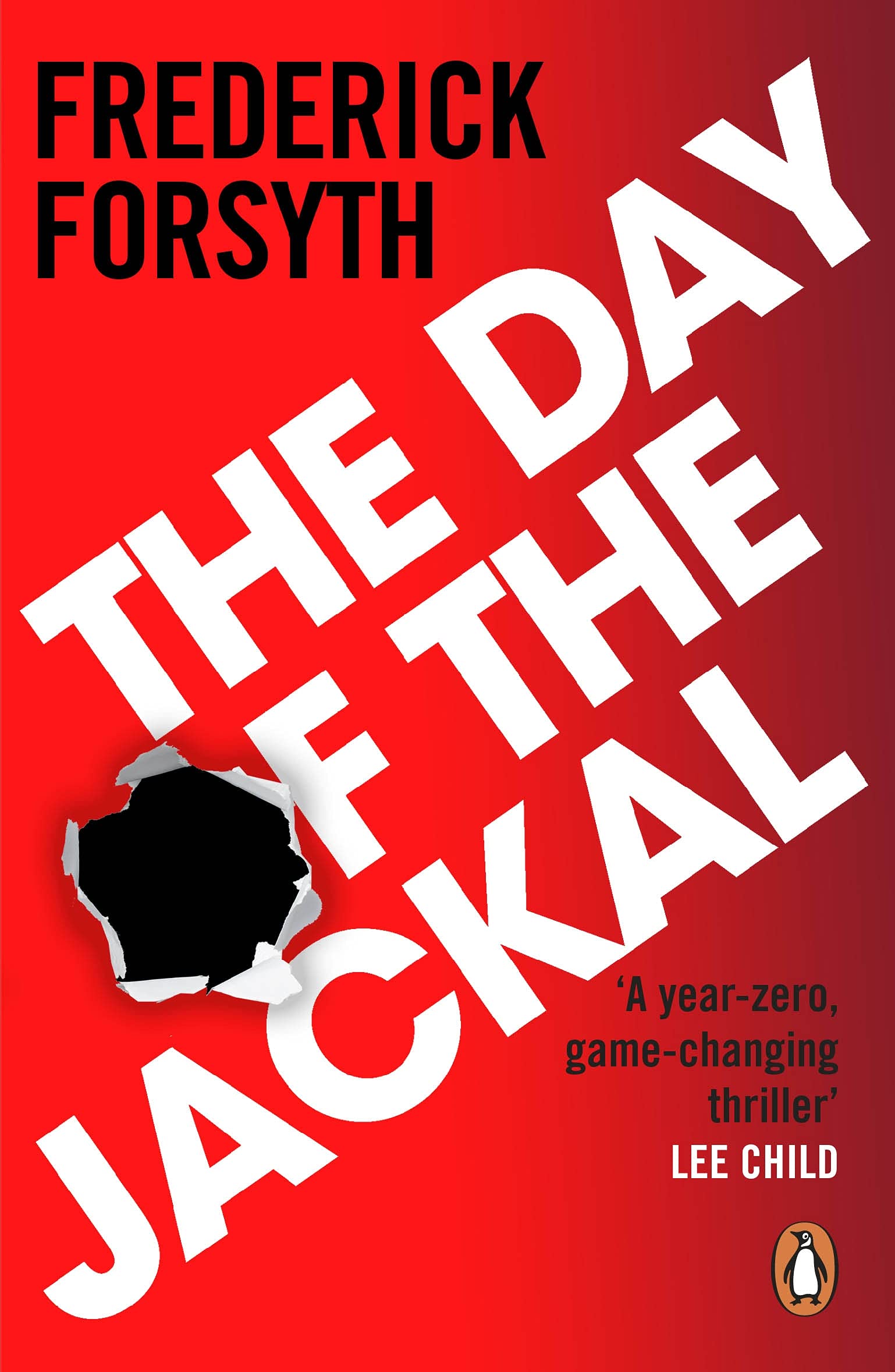
Rating: 8/10
- Plot: Right-wing French militants hire a foreign professional to assassinate de Gaulle, and a quiet detective races to identify him.
- Clues: A manhunt built from passports, border checks, hotel registers and phone intercepts.
- Reveal: Everyone knows de Gaulle survived; the tension comes from how, and from the final question of who the Jackal was.
- Science bonus: The Jackal’s preparations are engineering and ballistics: a custom-built, disguisable rifle, calibrated and test-fired with meticulous attention to trajectory and effect.
In 1963 the OAS, the terrorist organisation of French officers opposed to Algerian independence, has failed repeatedly to kill Charles de Gaulle. Its leaders decide to hire an outsider, an English assassin known only by his code name. He plans meticulously. When French intelligence learns of the plot, Commissaire Claude Lebel, a modest, methodical detective, is given the job of finding a man with no name.
Frederick Forsyth was a Reuters correspondent in Paris during the OAS years, and his book reads like reportage. Its innovation was to treat the assassin’s preparations as procedure: acquiring a false identity, commissioning a specially made rifle, testing it, planning the route. The level of detail was so convincing that at least one of the methods was later used by real criminals.
The pleasure lies in the intercutting between the Jackal’s cold efficiency and Lebel’s patient investigation. Both are professionals, and the novel respects competence.
The characters are thin. The Jackal is a blank by design, and Lebel is mostly defined by his work. Women appear mainly as means to an end. The prose is functional, sometimes like a briefing. The 8 reflects a model of the procedural thriller, compulsively readable even though the reader knows the outcome. It changed the genre, and Fred Zinnemann’s 1973 film is a faithful companion


Leave a Reply