Rating: 6/10 · Translated from Russian
- Accuracy: Exhaustive on the Russian defeat at Tannenberg, drawing on military records; later editions added long sections on Stolypin.
- Readability: Heavy, with dense military detail and a very large cast.
- Plot: The opening weeks of the First World War, as a Russian army advances into East Prussia and is destroyed.
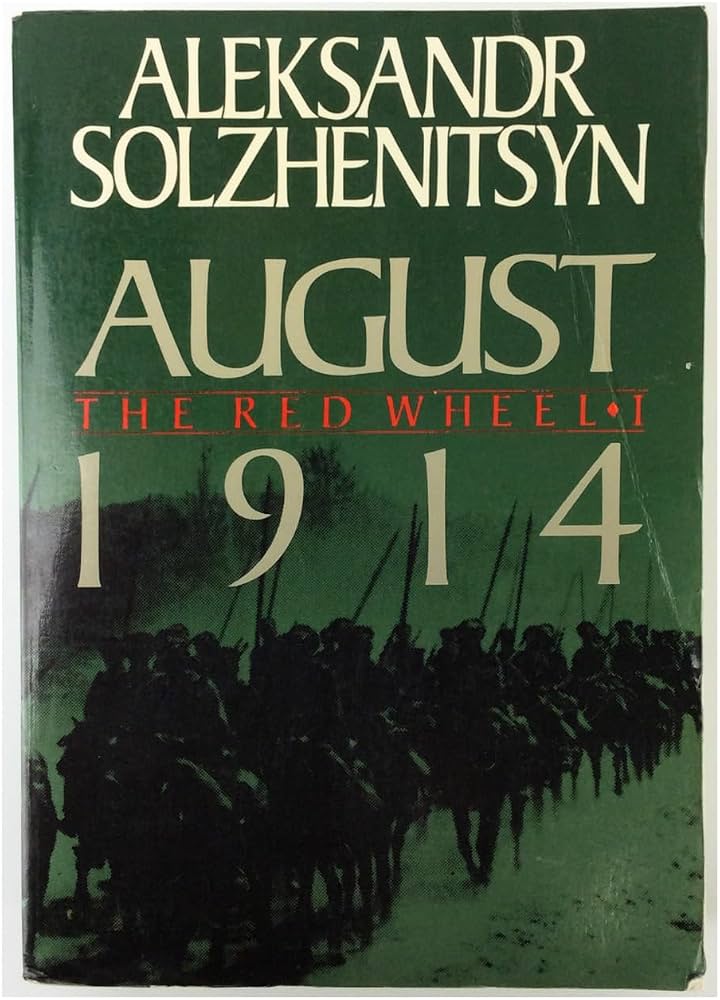
In August 1914 two Russian armies invade East Prussia. General Samsonov’s Second Army advances into a trap and is encircled and destroyed at Tannenberg. Samsonov shoots himself. Aleksandr Solzhenitsyn follows the campaign through generals, officers, soldiers and civilians.
This was the first “knot” of Solzhenitsyn’s vast cycle The Red Wheel, which aimed to explain how Russia came to revolution. It was published abroad because it could not appear in the Soviet Union. The novel mixes fiction with documents, newspaper extracts and cinematic sequences.
The military sections are the book’s strength. Solzhenitsyn shows the Russian command’s incompetence, the chaos of communications, and the courage of ordinary soldiers. Colonel Vorotyntsev, a staff officer trying to make sense of the disaster, is a strong central figure.
The civilian sections are less successful. Characters are often vehicles for arguments about Russian history. The later expanded edition, with its long treatment of the assassination of Prime Minister Stolypin, makes the book even more unwieldy.
The prose, in translation, can be flat, and the density of military information can overwhelm.
The 6 reflects an ambitious and important work that is more impressive than enjoyable. It is essential for readers interested in Solzhenitsyn or in the Russian road to 1917, but others may prefer a history.


Leave a Reply