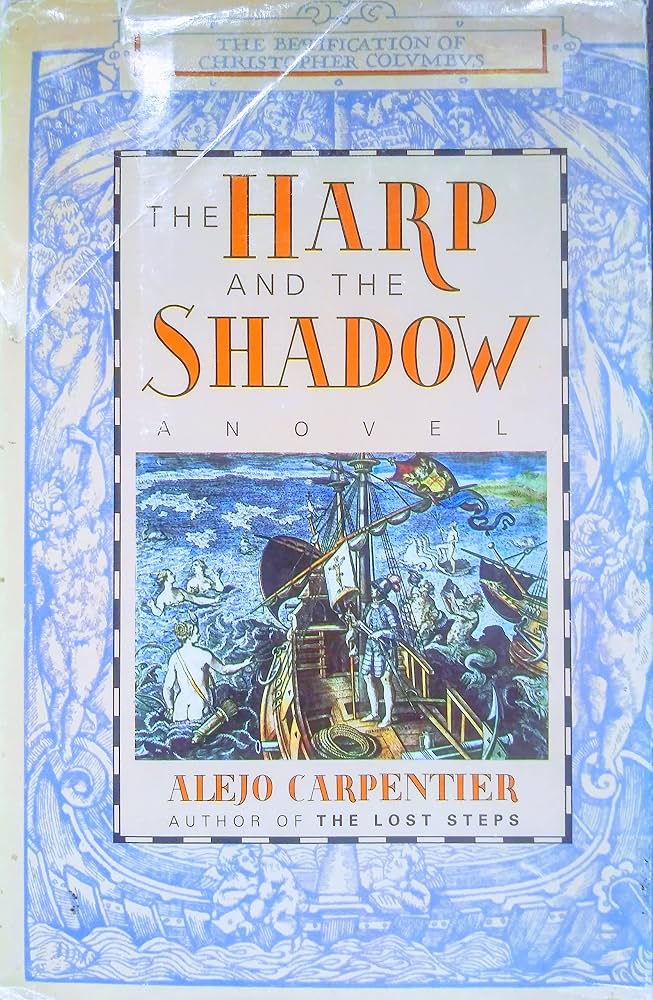
Rating: 7/10 · Translated from Spanish
- Accuracy: Based on real nineteenth-century attempts to beatify Columbus and on Columbus’s own writings.
- Readability: Short, witty and erudite.
- Plot: A pope promotes Columbus’s canonisation, the dying Columbus confesses his deceptions, and a heavenly tribunal debates his sainthood.
- Science bonus: Columbus’s confession exposes his navigational reckoning, including the distances he falsified in his logs, as part of the myth he built.
Alejo Carpentier’s final novel is in three parts. First, Pope Pius IX, who as a young man visited South America, decides to promote the beatification of Christopher Columbus. Then Columbus, on his deathbed, prepares to confess and reflects on his life, revealing ambition, lies and cruelty. Finally, in a comic tribunal, Columbus’s case is debated before witnesses from history and literature.
The novel is a meditation on myth-making and history. Columbus is shown not as a saint or villain but as a man who invented his own story. His confession reveals his manipulation of patrons, his greed for gold, and the enslavement of Indigenous people.
Carpentier’s prose is baroque but less dense than in his earlier novels, and his irony is sharp. The final tribunal is a playful fantasy that questions how history judges its heroes.
The weakness is that the three parts are uneven, and the tribunal can feel like an intellectual game. Readers seeking historical immersion may be disappointed.
The 7 reflects a clever, witty and thoughtful novel, a fitting final work from one of Latin America’s great writers, who died the following year.


Leave a Reply