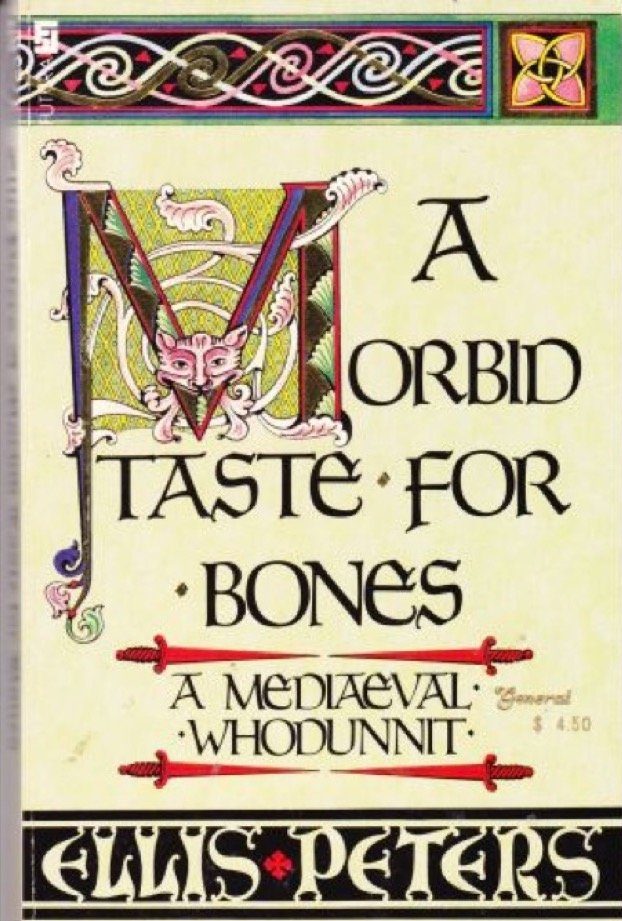
Rating: 8/10
- Accuracy: Well grounded in twelfth-century England and Wales, from monastic life to Welsh law and customs.
- Plot: In 1137, monks of Shrewsbury Abbey travel to a Welsh village to take the bones of a saint, and a local lord who opposes them is found dead.
- Clues: Fair and humane, with Cadfael’s knowledge of herbs and people central.
- Reveal: Satisfying and morally generous.
- Science bonus: Cadfael is a herbalist and practical physician, and his knowledge of plants, wounds and bodies is the basis of his detection.
Prior Robert of Shrewsbury Abbey wants to acquire the relics of Saint Winifred, buried in the Welsh village of Gwytherin. He leads a small party of monks there, including Brother Cadfael, a Welsh former soldier and sailor who became a monk and herbalist. When the leading villager, Rhisiart, who opposes the removal, is found dead, Cadfael investigates.
Ellis Peters, the pen name of Edith Pargeter, created in Cadfael one of the most beloved detectives in crime fiction. He is wise, tolerant, humorous and practical, a man who has seen the world and chosen peace. His knowledge of herbs, medicine and human nature makes him an ideal investigator.
The novel’s portrayal of medieval life is rich and convincing, and the Welsh setting is especially appealing. Peters shows the clash between church ambition and local faith with irony.
The mystery is well constructed, and the solution reflects Cadfael’s sense of justice. There is also a romance between young people that became a series trademark.
The weakness is a slightly slow start and a somewhat sentimental tone. Some later Cadfael books are stronger mysteries.
The 8 reflects the founding book of the modern historical mystery. The Cadfael series ran to twenty novels and was adapted for television with Derek Jacobi.


Leave a Reply