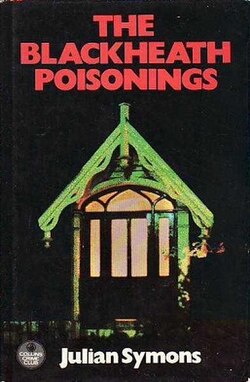
Rating: 7/10
- Accuracy: Strong on Victorian middle-class family life, law and the social importance of respectability.
- Plot: Two related families share a large house in Blackheath, and a series of deaths by poison exposes their secrets.
- Clues: Carefully laid and fair.
- Reveal: Clever, with a sharp satirical edge.
- Science bonus: Arsenic toxicology and the forensic evidence presented at trial shape the case, reflecting the growing role of chemical analysis in Victorian courts.
In the 1890s, two families linked by a business in toys live in neighbouring houses in Blackheath. When the head of one family dies, apparently of illness, suspicion grows that he was poisoned. More deaths follow, and a trial reveals scandals behind the respectable facade.
Julian Symons was a leading critic of crime fiction, and his history of the genre, Bloody Murder, remains influential. He wrote novels that used the genre to examine society, and The Blackheath Poisonings is a satire of Victorian values: money, class, sexual hypocrisy and the obsession with appearances.
The narrator, a young man in one of the families, gives the book an ironic perspective. The trial scenes are effective, and the resolution is clever.
The weaknesses are a slow pace and characters who are more social types than individuals. The satirical tone can be cool. The 7 reflects a sophisticated historical mystery that is as interested in society as in crime. It was adapted for television in 1992.


Leave a Reply