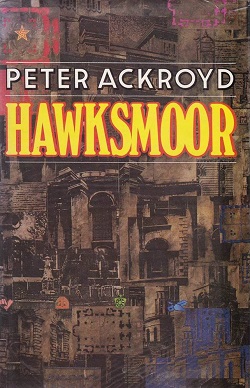
Rating: 8/10
- Accuracy: Rich on eighteenth-century London and its churches, loosely based on the architect Nicholas Hawksmoor, with a fictional architect as narrator.
- Plot: An architect building London churches in the early 1700s makes secret sacrifices; in the 1980s a detective named Hawksmoor investigates murders at the same churches.
- Clues: Mirrored across centuries, but the detective’s rational methods fail.
- Reveal: Mystical and unresolved, collapsing the two time periods together.
- Science bonus: Dyer’s occult architecture is set against the rational science of Wren and the Royal Society, and the novel dramatises the clash between Enlightenment reason and older beliefs.
In the early eighteenth century, Nicholas Dyer, an architect working on new churches in London, secretly practises occult rituals and sacrifices victims to consecrate the buildings. In the 1980s, Detective Superintendent Nicholas Hawksmoor investigates a series of murders at the same churches.
Peter Ackroyd alternates the two stories. Dyer’s chapters are written in convincing eighteenth-century English, full of dark humour and paranoia. Hawksmoor’s chapters are modern, but they echo Dyer’s.
The novel is a meditation on time, place and the persistence of the past. London’s churches become sites of hidden power. The echoes between the two periods are clever and eerie.
The mystery is not solved in conventional terms, and the ending is ambiguous. The modern detective is less vivid than Dyer.
The weakness is that the novel’s ideas are more compelling than its plot, and some readers find it cold.
The 8 reflects an original and haunting novel that won the Whitbread Novel Award and the Guardian Fiction Prize.
The novel is intellectually exciting, and the interrogations are superbly written. Fowles captures the period’s language and mindset.
The weakness is that the ending frustrates readers who want a solution. The novel is more philosophical than mysterious.
The 8 reflects an ambitious, intriguing novel, one of Fowles’s most original books, though its refusal of closure divides readers.


Leave a Reply