Rating: 6/10
- Accuracy: Lively on Regency London’s prisons, boxing, gaming and dress, but the history serves the adventure.
- Plot: A condemned man in Newgate marries a noblewoman on the eve of his execution, then finds himself unexpectedly free.
- Clues: Present but secondary; the question of who framed him runs beneath a great deal of swordplay.
- Reveal: Competent but not memorable.
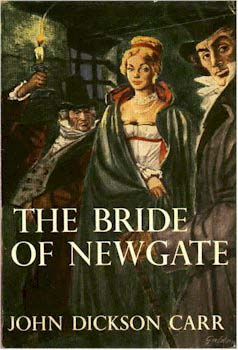
In June 1815, Dick Darwent sits in Newgate awaiting execution for a murder he did not commit. Lady Caroline Ross, who must marry by a deadline to inherit, arranges a brief marriage with a condemned man, expecting to be a widow by morning. Then Darwent’s fortunes turn overnight, leaving him free, married, and determined to find out who framed him.
The premise is excellent, and the opening chapters in Newgate are vivid, catching the prison’s squalor, corruption and theatrical cruelty. Carr’s fondness for Regency London shows in the gaming houses, prize fights and clubs.
This was Carr’s first full-length historical mystery, and it reads like an experiment. The puzzle is there, with a murder, false evidence and hidden motives, but it often yields to duels and confrontations. Darwent is an action hero in the Sabatini mould, capable and brave but not especially interesting.
Lady Caroline is more intriguing: proud, calculating, and forced to live with the consequences of her scheme. The relationship between them has promise, but Carr resolves it predictably.
The solution to the frame-up is logical but lacks the sleight of hand of his best work, and the villain is not hard to spot.
The 6 reflects an energetic adventure with a fine opening and a weaker mystery. It is best read as a sign of where Carr was heading rather than as one of his finest achievements.


Leave a Reply